I am writing this on a Sunday morning, with a cup of coffee made the way my mother taught me. The window is open. The clinic does not open until tomorrow. I keep thinking about a patient I will never meet.
On a Tuesday evening at 7:42, she ordered a doctor on her phone. She answered eleven questions. She photographed an old prescription bottle. She submitted. Somewhere, someone she will never see read the answers and approved the refill. By morning, the medication was at her door. She rated the experience five stars.
I am the doctor she did not order. I want to tell you what that doctor carries, because I think she lost something in those eleven questions, and no one told her it was the part that mattered.
This is not a complaint about the app. The app was honest. The complaint is a different essay. This is an accounting.
The refill used to run through a person
For most of medicine, a refill ran through a person. You called an office, and the call put you back in front of someone who had seen you before and would see you again. The medication never changed. The call was the point. It was a reason to look at you again.
The order removed the call. Not the medication, not the convenience. It removed the person on the other end who had been keeping track. To tell you what that person did, I have to tell you where I learned to be one.
What Dr. H taught me
Fifteen years ago, when I was a fellow in pediatric hematology, I learned the lesson that has shaped the kind of doctor I am. The patient on the schedule is not the same person as the patient who walks into the room.
The patient on the schedule is a name, an MRN, a problem list, and a billing code. The patient who walks into the room is a sixteen-year-old tired of being the kid who misses school for transfusions. She is a mother who has not slept because her son was up all night in a pain crisis, and nothing she did reached it. He is a teenager who hides how much it hurts because he wants to play on Friday. The visit is the moment those two people meet. The work is to know the one who walked in.
I learned this from my fellowship mentor. I will call him Dr. H. He had followed some of his patients for thirty years. He knew them, not their charts, them. He told me the work was to know the person in front of you, and that trust is built one small act of remembering at a time.
So I learned to remember. I kept little notes, sticky notes, back when charts were still paper, on the things that never reach a medical record. The game that a teenager would not stop talking about. The sibling who carries the trait, too. The exam she was dreading, the college the family was waiting on, the season that always brought the pain. Before I walked into a room, I reminded myself who this person was, underneath the diagnosis.
It was a small habit. It changed the whole visit. The teenager walked in, and I asked whether she made the team. The mother saw that I remembered her younger son had been admitted the month before. They felt known. That was the work. Not only the diagnosis or the plan. Knowing them.
That is the doctor, Dr. H, who made me. The relationship was never the wrapping around the care. It was the care. I became part of their lives, and in a way, I am still working out how to say they became part of mine.
I am writing this because the model now arriving in medicine has no place for that, and I do not think it is a secret. It simply does not see it.
What the platform leaves out
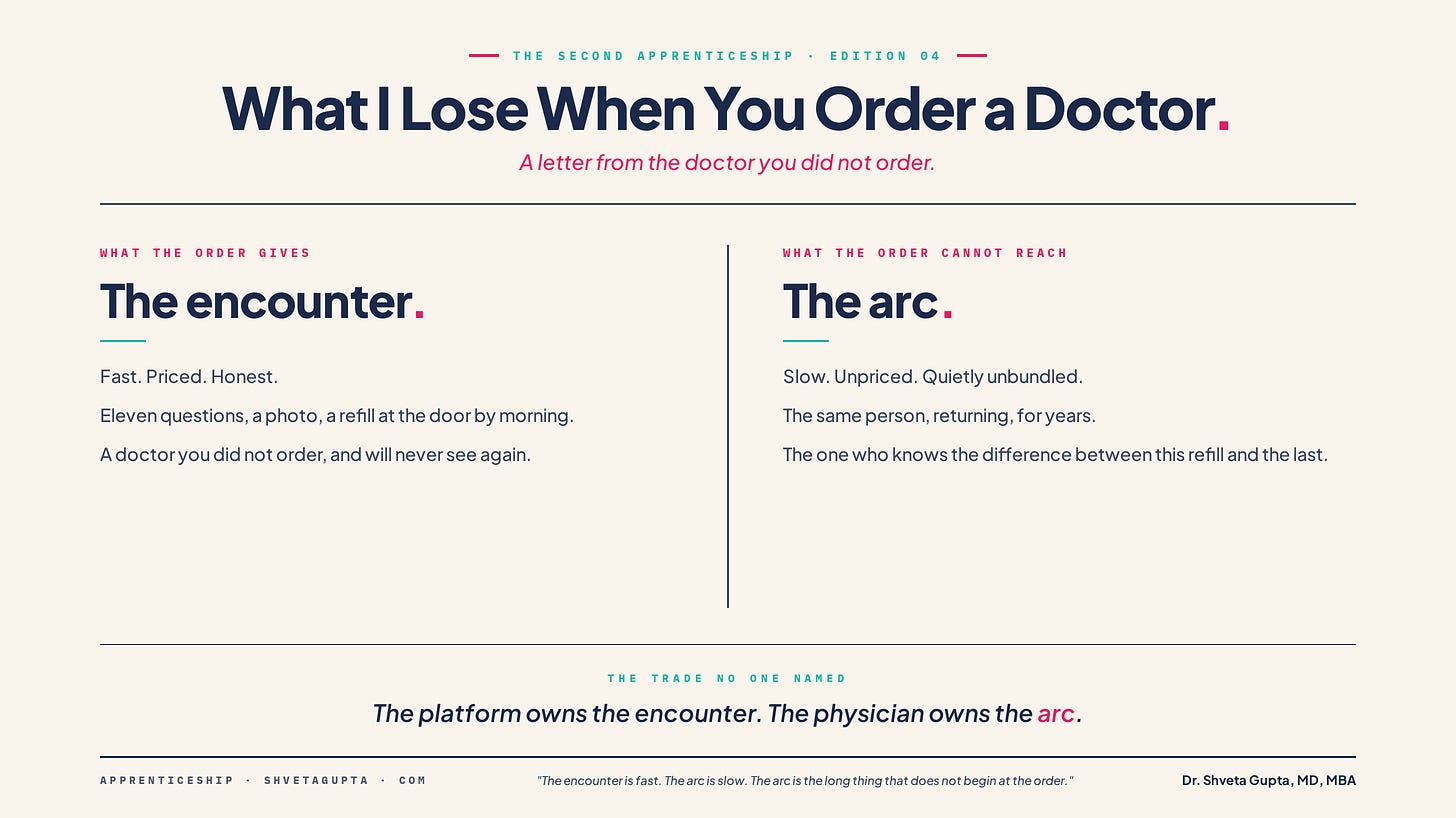
The platform is built on a clean idea. The chart is the patient. Anyone who can read the chart can treat the patient. The chart transfers, the clinician is interchangeable, the encounter is the unit, and the minute is the price. For a refill, the idea works.
The chart was never the patient's. The chart is the record of the visit. The patient is the person who walked in. Everything Dr. H taught me lives in the space between the two, and the platform does not see that space, because seeing it takes time, the platform has no way to price.
What the platform keeps is the transaction. What it leaves out is the relationship. Not because anyone decided the relationship did not matter. Because the relationship has no unit. You buy the pill, not the knowing. You rate the encounter, not the years. The relationship has only time and the same person returning. That is the part the order never reaches, and the part I have spent fifteen years learning to give.
And if you are a physician reading this
I have been writing about a patient I will never meet. I think most of you reading are not patients. You are physicians, and this lands differently in your hands.
If you are still inside clinical practice and feeling the medicine shift under you, you already know the knowing is the part you were trained to give and the part the system has stopped counting. You are not imagining the loss. You are naming it.
If you are thinking about leaving, you might recognize the harder version of the question. Not whether another path exists. Whether the thing you are best at, the knowing, the watching, the arc, has any name once you step outside the room where everyone understood it without being told.
If you are already outside, you have met the translation problem directly. The capacity is intact. The vocabulary for it is missing. The watching does not show up on a resume. This is what I have started calling the Untranslated Physician, the person who carries the skill and lacks the words for it in the new room.
I am not writing any of this from above it. I am asking the same question. I am an employed physician in the same corporatized medicine that built the platform, practicing under targets that price my time the way the app prices reviews, watching continuity get dismantled around me, and showing up on Monday anyway. The term for the gap between the work you trained for and the institution where you practice is moral injury, coined by Wendy Dean and Simon Talbot in 2018. Burnout is the symptom. The injury is older.
The second apprenticeship
The first apprenticeship made me a clinician. It taught me the visit, the chart, the protocol, and the night call. It assumed the room would always understand what I was for.
The second apprenticeship begins after the room has been rewritten. It asks a harder thing. To see clearly what is being unbundled. To hold the part that has no price. And to learn to say what it is, in language the next room recognizes, without losing the thing the work was. The room where the platform was designed did not have a physician in it. The room where the next one is designed will not either, unless the physicians who carry the arc learn to walk in with a vocabulary it understands.
That is the apprenticeship I am in. This publication is where I am working it out, in the open, alongside whoever else is at the same threshold. I do not have the finished version. I have the question and the conviction that the knowing is worth carrying even after the system stops paying for it.
You are not starting from zero. You are starting from everything you have already carried.
The platform owns the encounter. The physician owns the arc.
I will not out-deliver the app, and I am not going to pretend otherwise. It is here. The economics are honest. Tuesday evening at 7:42 is real. The refill mattered. She got what she ordered.
What is left to me is to name what the app does not own, and to carry it on purpose. The encounter is fast. The arc is slow. The arc is the long thing that does not begin at the order, and it is what she gave up without being told there was anything to give up.
If you are working through the same threshold, I would value your company here. Subscribe, and work it out alongside me.
Yours, The doctor you did not order.
A note on the framework
The second apprenticeship is my synthesis, not a validated model. It draws from work on professional identity formation (Cruess and Cruess), working identity and career transition (Ibarra), role exit (Ebaugh), and learning that requires unlearning the frame in which you were trained (Bateson). The naming is interpretive. The literature underneath it is well established. The publication’s project over the coming year is to test how well the frame holds up when physicians apply it to their own lives. The fuller architecture is in the book I am writing.
Sources
Wendy Dean and Simon Talbot, “Physicians aren’t ‘burning out.’ They’re suffering from moral injury,” STAT News, 2018. https://www.statnews.com/2018/07/26/physicians-not-burning-out-they-are-suffering-moral-injury/