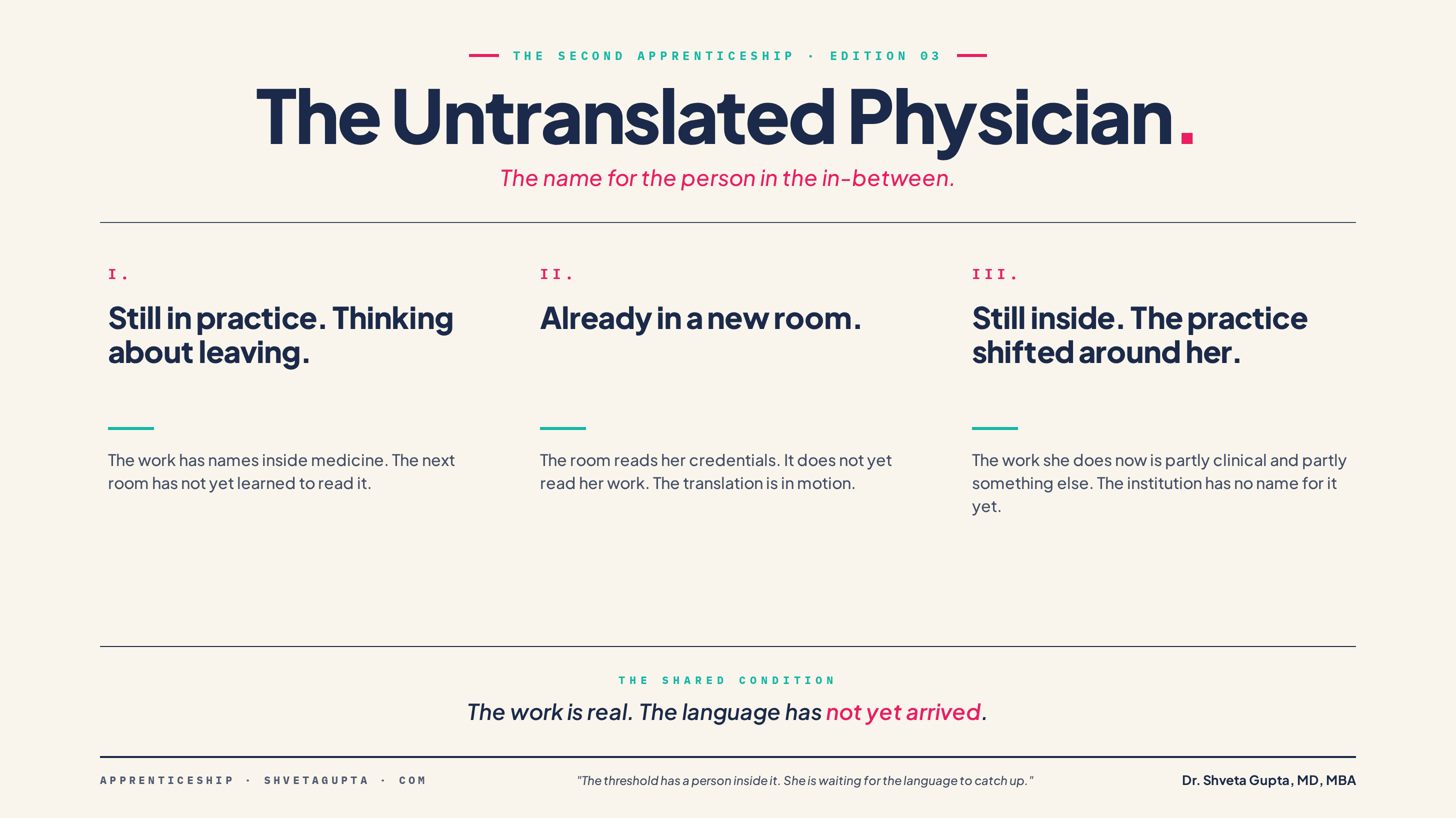
The Untranslated Physician.
Edition 03. The name for the person in the in-between.

Last edition I named what gets left behind in the false reading of zero. The work survives the sort. The capacity continues. The role changes. The capability does not begin again.
This edition names what walks across the threshold without a name.
The False Zero has a person inside it. I have been one of them. So has every physician I know who has stood at this threshold.
She has a name now. I have been calling her the Untranslated Physician.
The construct
The Untranslated Physician is the person at the threshold whose richness has not yet been named in language the next room reads.
She is not unprepared. She is unread.
The credentials are real. The training is real. The years are real. The work is real. The reading is missing. Both can be true at the same time, and most of the difficulty of the threshold sits in holding them both at once.
The threshold has three common positions.
The first position. The physician still in full clinical practice, thinking about leaving. She has been doing the work for ten, fifteen, twenty years. The work she has done has names inside medicine. The work does not yet have names in the rooms she is being asked to enter. Advisory. Consulting. Industry. Founder. Executive. She knows the work is real. She does not yet know how to say what the work was, in a language the next room reads.
The second position. The physician who has already left clinical practice. She is in a new room now. Some weeks the new room reads her credentials but not yet her work. Some weeks the room does not know what to do with her clinical past. Some weeks she does not know what to do with it either. The translation work is in motion. The reading has not yet caught up.
The third position. The physician who has not left clinical practice, and may not leave, but the practice has shifted under her. The work she does now is partly clinical and partly something else. The something else has no name inside medicine. She is co-designing AI workflows with vendors. She is leading care-model redesign across a system. She is being pulled into payer conversations the institution never trained her for. The work is real. The institution has not yet learned to read it. She is doing translation work without anyone naming it as translation work.
All three positions share one condition. The language to describe what you do, what you have done, or where you are going does not yet exist in a form the next room reads. Each of the three has a slightly different version of the same problem. All three are the Untranslated Physician.
The Untranslated Physician is not a permanent identity. It is a position. A threshold position. You walk out of it by doing the language work, not by waiting to be discovered. The first apprenticeship made you a clinician. The second apprenticeship is the one where you build the sentences to let yourself be read in the rooms you have not yet entered, or the rooms you are already in, or the rooms the practice has quietly turned into.
The in-between is not a void. It is a place. The place has a name.
The scene
A friend texted me late one Sunday evening in the spring of 2025. We went to medical school together. We did call together. We sat next to each other at the white-coat ceremony. She had been thinking about leaving full-time clinical work for almost two years. She asked if I would look at her LinkedIn page.
I opened it on my laptop. I read her About section.
It said she was a board-certified physician with twenty years of practice in her specialty. It said she had cared for patients across academic and community settings. It said she was passionate about patient outcomes and committed to clinical excellence.
The sentence was true. The sentence was also a near-perfect copy of the sentence I had stared at in my own page six months earlier.
I sat with her profile open for a long time.
I knew this woman. I had watched her run a labor and delivery unit at three in the morning with a calm I have rarely seen in any operator I have met since. She had built a teaching program from nothing. She had restructured a clinic’s intake operations after the system imploded during the pandemic. She had served on the institutional review board for seven years. She had advocated for an entire patient population inside a hospital system ready to defund the work.
None of this was in the About section. Twenty years compressed into three sentences about clinical excellence.
I started typing a reply to her. I deleted it. I typed again. I deleted it again.
The thing I wanted to write was not feedback on her profile. The thing I wanted to write was, you are not the problem. The page is doing the same compression mine did. The page is not reading you.
The recognition arrived slowly. The compression I had felt in my own profile was not personal. It was structural. The page I had been writing in was the same page she was writing in. The same page every physician I have watched make this move has been writing in.
We were all the Untranslated Physician. Each of us thought we were the only one. None of us was.
I sent her a different message instead. I told her the work she had done was real and the words for it existed. I told her the bio would not write itself but the bio would be written. I told her I would help.
She wrote back. She said, “I do not know what to call any of it.”
Her sentence has stayed with me. It is the sentence under the False Zero. It is the condition under the construct. The work was there. The language was not. The Untranslated Physician is the person sitting with both.
Why the condition persists
A few patterns explain why the Untranslated Physician is the common position rather than the exceptional one.
The first is medical training never taught legibility as a separate skill. Jeremy Branzetti and colleagues, in Medical Education in 2025, applied brand-management language to physician professional identity. Their argument is physicians who do not actively build a personal brand get read through institutional roles by default. The credentialing system produces credibility. It does not produce a reading. Medicine has not yet treated personal legibility as a competence worth building consciously.
The second is the credentialing system is built to consolidate identity around the institutional role rather than around the person inside the role. The clinical title does the work of introduction. The badge does the work of standing. The page in the directory does the work of presence. When the role goes quiet, or shifts, or no longer fits, the apparatus doing the reading goes quiet with it. The person remains. The system reading her does not.
The third is physicians are largely absent from the rooms where decisions about clinical AI, payment models, and care redesign get made. Hameed and colleagues, in JAMA Network Open in 2021, studied physicians at top US academic hospitals. Roughly 70 percent had a social media profile. Roughly 90 percent posted nothing in a typical month. The audience needing to read you is one you have rarely been visible to. The vocabulary you would need to be read by them is one you have rarely been asked to speak.
These three forces combine. You are findable. You are credible. You are unread. Findable is not the same as influential. Credible is not the same as legible. The Untranslated Physician sits at the intersection of all three, regardless of which of the three positions she is standing in.
The condition is not a failure of the physician. It is a feature of the training itself.
The product without a product manager
I have been borrowing a frame from outside medicine to think about this.
In a company, a product without a product manager is something existing, with features, with users, and with value, with no one whose job it is to translate the product into language the market reads. The product is good. The product is real. The product is not being read by the people who would buy it.
A physician at the threshold is in this position. The product is the body of work. The product manager has not yet been assigned. In most physician careers, no one has ever been assigned. Medicine assumed the institution would do the reading.
The institution will not do the reading in the next room. It will not do the reading in the room you are already in. It will not do the reading for the parts of the practice the institution itself has not yet caught up to. The person who does the reading is the physician herself. The role has a name in the room you are walking into, or the room you have already entered, or the room the practice has quietly become. We will return to the role next edition.
For now, what matters is the recognition. You are not unprepared. You are unread. There is a name for the role solving the reading problem. You have not yet stepped into it.
A note on what I am building from
The Untranslated Physician is a synthesis I needed in order to make sense of what I was watching, in myself and in the physicians I trained with. Several thinkers were already pointing at pieces of it.
James Marcia (1966) described identity foreclosure. James Hollis, 1993 and 2005, wrote about the unlived life. Herminia Ibarra (2003 and 2023) framed working identity as something assembled through experiments rather than declared. Mary Catherine Bateson (1989) called it composing a life. David Brooks (2022) wrote about the second mountain. Suzanne Koven (2021) wrote about the practice underneath the practice. Jeremy Branzetti and colleagues (2025) applied brand-management language to physician professional identity. Hameed and colleagues (2021) measured physician social media presence at top US academic hospitals and documented how rarely physicians post in public-facing settings.
These thinkers each named a piece of the threshold. The synthesis I needed was different. The False Zero named the cognitive distortion. The Untranslated Physician names the person standing inside the distortion. The two together do work neither does alone.
The synthesis is mine. The book makes the case in full. This edition shows the move.
The close
The threshold has a person inside it. She is not waiting to become someone. She already is someone. She is waiting for the language to catch up.
You are the Untranslated Physician whether you are thinking about leaving, already in a new room, or still inside watching the practice shift under you. The condition is the same. The work is real. The language has not yet arrived.
This is a position, not a void. It has a name now. The name is yours to walk out of, on your own timing, into rooms not yet able to read you.
Next edition. The role solving the reading problem. Product manager of one.
— Shveta