

At 11:47 am, a message lands in the clinic inbox. A patient needs to be added before the afternoon session. The schedule has nothing open, so someone creates a 15-minute slot at noon.
The request arrives looking contained. One patient, one slot, one number. Not one of the three describes an illness.
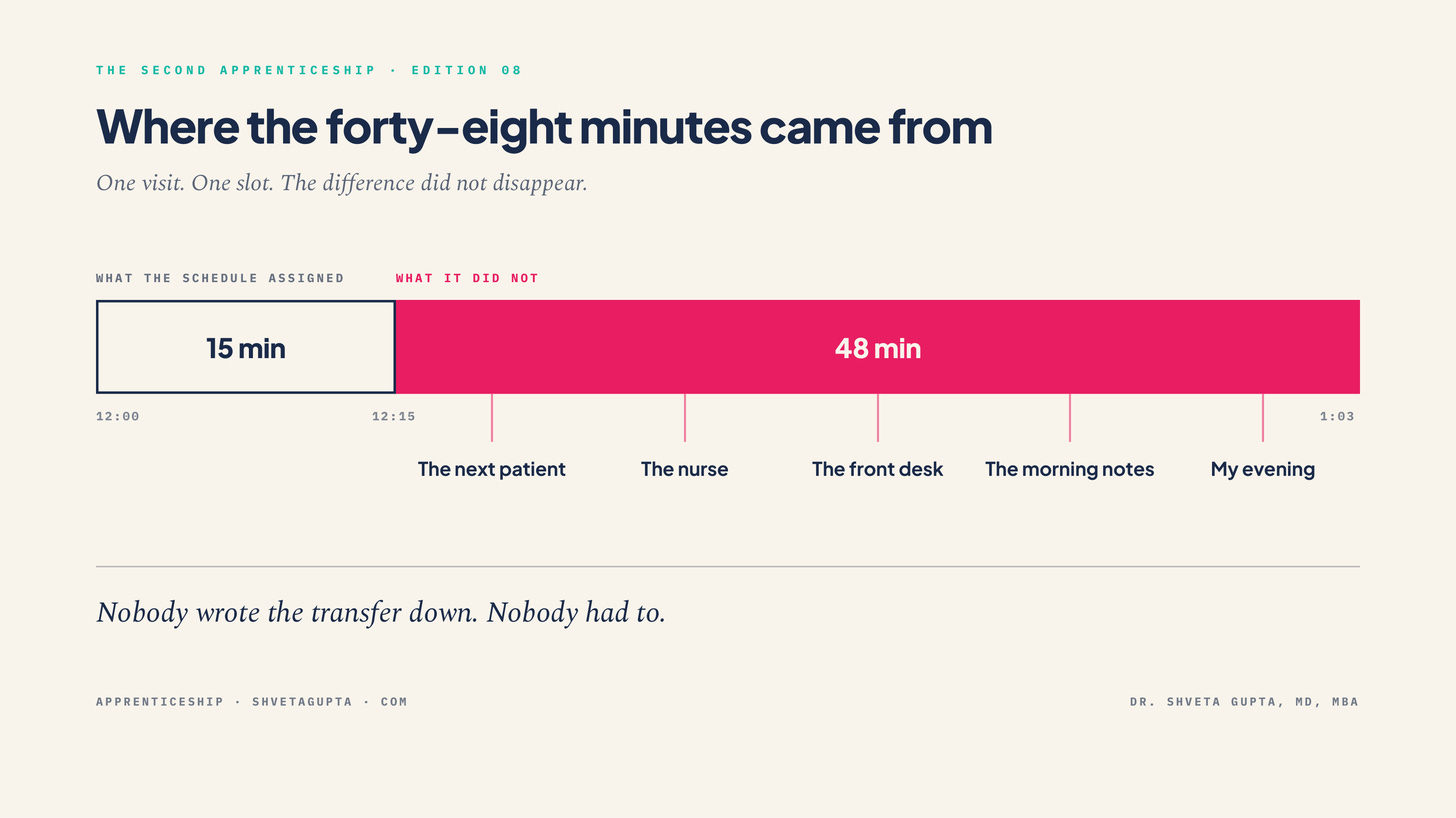
The visit starts, and the concern is larger than the message suggested. The history needs room. The examination raises a second issue. The plan needs to be explained, and it needs a phone call before the patient leaves. At 12:15, the next patient has arrived, the nurse is waiting on an answer, and the template still reads fifteen minutes.
I stay in the room. At 1:03, the visit ends.
The choice was never really a choice
I did not set the duration, the placement, or the sequence. I answer for every decision inside all three.
Once the assigned time ran out, there were two moves. Stay, and everyone behind me waits. Stop, and the clinical work goes unfinished. Neither one hands back any control over the schedule. The only question was who absorbs the shortfall, and the answer was already arranged before I opened the door.
Fifteen minutes encodes access targets, staffing, and financial constraints. It encodes no clinical finding because no one had examined the patient when the number was assigned.
The slot belonged to the system. The patient belonged to me.
The cost did not stay with me
A 2024 qualitative study interviewed 25 primary care physicians across 11 states about time constraints, and though it is small and confined to primary care, the language belongs beside an hour like this one. The physicians reported a mismatch between the hours allocated to their work and the work expected of them. The researchers called it constant time scarcity. One participant put it plainly: “It always feels like I’m letting someone down.”
What holds my attention is the direction the guilt travels. It moves outward in every direction at once. Staying with one patient leaves another waiting. Work finished after clinic takes the evening from someone at home. Running late keeps the nurse and the front desk past their own hours.
Protecting one obligation never resolves the shortage. It relocates it, usually onto someone with less standing to object.
Time is missing from the definition
Autonomy in medicine is described as authority over clinical decisions. Time rarely makes it into the definition, and the omission does real work.
A physician needs enough room to gather information, sit with uncertainty, explain it, and build a plan someone will follow. Judgment thins when the length of the thinking is fixed before the thinking starts.
A 2025 cross-sectional study of physicians in large organizations found 58.3 percent of the 1,186 answering reported sufficient authority over the work for which they were held accountable, with poor control across several domains associated with burnout. Association rather than cause, and one sample rather than every practice.
None of this means a physician decides every operational detail. Patients need access. Teams need predictable days. Clinics need to plan capacity, and a physician who ignores all three is not exercising judgment.
It means holding a real voice at the moment planned time and clinical need come apart, which only ever happens after the visit has started.
The part medicine made moral
Edition 01 sorted the cost of leaving clinical practice into four kinds. Two of them are useful here.
The patient’s need was real. The belief tying a boundary to professional failure was inherited.
Training rewards the physician who stays until the work is finished, and the reward exists for good reason. It protects patients. It also gives an institution a dependable answer whenever a fixed template meets a variable illness, because someone will supply the missing time from their own life, and everyone knows who.
The lesson turns moral before anyone says it aloud. Staying reads as commitment. Running behind reads as inefficiency. Asking for longer visits reads as a reduction in access. Declining the add-on reads as handing your patient to a colleague. Every description leaves the same person accountable.
I want to be careful with the inherited cost, because it carries something true. A physician who feels nothing when a patient waits has lost something worth keeping. The trouble is an obligation with no matching authority, absorbed privately, by whoever happens to be in the room.
What remains
The visit was complete, and I would stay again. None of it is regrettable.
What arrived at 11:47 was not an appointment request. It was a transfer. The consequences of an unrealistic slot fell on me, the patients behind the door, the staff who stayed late, and whatever was supposed to happen in my evening. Nobody wrote the transfer down. Nobody had to.
If you are working through this too, subscribe and work it out alongside me.
Shveta
Sources
Nguyen, et al. Primary care physician perspectives on time constraints. JAMA Network Open, 2024. Qualitative, 25 physicians across 11 states. https://pmc.ncbi.nlm.nih.gov/articles/PMC11061766/
Sinsky, et al. Physician control over the clinical schedule and authority over accountable work. Annals of Internal Medicine, 2025. Cross-sectional, 1,186 physicians answering the authority item. https://pubmed.ncbi.nlm.nih.gov/39586098/
Edition 01, Some of the Cost Is Not Yours, for the four costs.